Waking up at night to pee: two problems, one night
Waking at night to pee is often two problems: the bladder, and the hour you lie awake afterwards. How to tell which is which, and what helps each.

Vaibhav Shah, Pharmacist Independent Prescriber
2.10am. Up again. Shuffle to the bathroom in the dark, back to bed.
2.15am. Lying there. The house is quiet. Your head isn't.
3.20am. Still awake.
4.30am. Up again.
You've probably put it down to age, or your prostate, or that last cup of tea. It's the kind of thing people put up with for years. But look at that night again. The toilet trip took five minutes. The lying awake took over an hour.
That's two problems, not one. This guide helps you work out which is which, and what to do about each.
Where Seona fits in
Seona is a UK online clinic for chronic insomnia, which is the "lying awake afterwards" half of this story. If you're regularly awake for long stretches after a toilet trip, check your eligibility for treatment: it's free and takes two minutes. If you're eligible, a UK GPhC-registered prescriber reviews your case within 24 hours, including your night-time toilet trips, your health and your medicines. Bladder and prostate symptoms still need your GP, and we'll say so if that's where you should start.
Problem one: the bladder
Waking at night one or more times to pee has a name: nocturia. It's a symptom rather than a disease, and it's common. Around half of adults over 65 get up at least once a night. One trip rarely bothers anyone. It tends to become a real problem at two or more trips a night.
It isn't only a men's problem. Prostate enlargement is a common cause in men, but women are affected too, through an overactive bladder, changes around menopause and other causes.
The usual suspects
Doctors usually group the causes into a few broad types:
| Suspect | What's going on | Examples |
|---|---|---|
| Too much urine at night | Your body makes more at night than the bladder can hold | Lots to drink in the evening, caffeine, alcohol; diabetes, heart failure; some water tablets, depending on when they're taken |
| A bladder that holds less | It feels full sooner | Prostate enlargement; overactive bladder |
| A sleep problem | You wake for another reason, then notice your bladder | Sleep apnoea; insomnia |
| A mixture | More than one at once | Very common in practice |
Problem two: the hour afterwards
This is the half that gets missed. Nocturia and insomnia often go together, especially in older adults, but they're different conditions and often need managing separately.
One study of older adults with insomnia tracked their nights for two weeks. More than half of their night-time awakenings involved a trip to the toilet, and on nights with a bathroom trip, time spent awake after first falling asleep was around a fifth longer.
And the effects add up. Nocturia is linked with poorer daytime functioning from sleep loss, a higher risk of falls and injury at night, lower quality of life and reduced productivity.
Bladder, brain, or both?
Here's the chicken-and-egg question. Did your bladder wake you, or were you already awake and then noticed it? Both happen. If your sleep is light and broken for other reasons, you surface more often, and a slightly full bladder is enough to get you up.
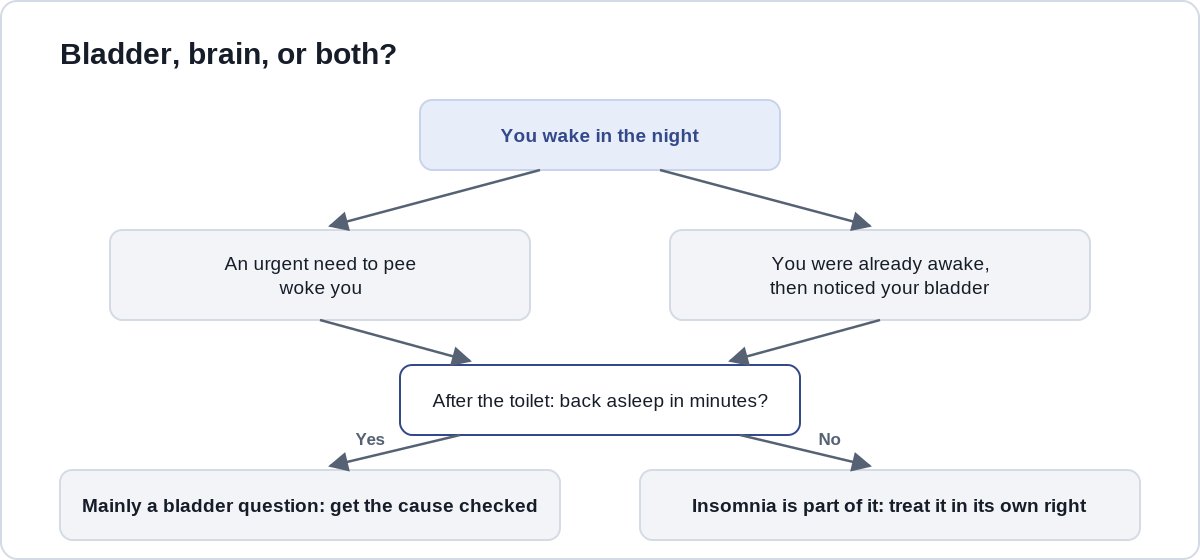
The simplest test is what happens next. Back asleep within a few minutes? The problem is mainly your bladder. Regularly lying awake for half an hour, an hour or longer? Something else is going on, and that something is often insomnia.
Insomnia is chronic when you have trouble getting to sleep, staying asleep or waking too early on at least three nights a week, for three months or more, and it affects your days. Our chronic insomnia guide explains it fully.
Gather the evidence
Two weeks of notes will tell you, and anyone you talk to, more than any amount of guessing. Write down when you go to bed, each time you wake, whether you went to the toilet, how long it took to get back to sleep, and what you drank in the evening. The Sleep Charity has a free sleep diary you can use.
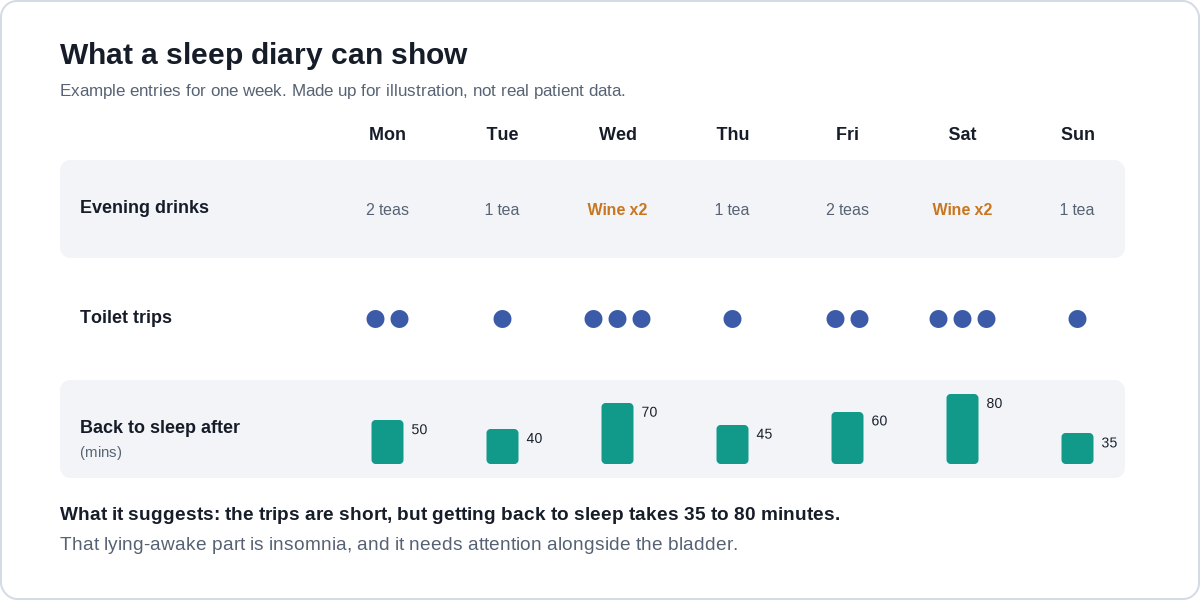
In an entry like the one above, the trips are short but the time awake is long. That's the pattern worth spotting, because it means fixing the bladder alone may not fix the nights.
Why fixing one may not fix the other
It's natural to assume that once the peeing is sorted, sleep will follow. Sometimes it does. Often it doesn't, because by the time someone asks for help, the insomnia has taken on a life of its own. Dreading bedtime, clock-watching and lying awake waiting for the next trip all keep insomnia going even after the original trigger improves.
That's why European sleep specialists, in their 2023 guideline, recommend CBT for insomnia as the first-line treatment for adults of any age, regardless of other health conditions. Having nocturia, a prostate problem or diabetes isn't a reason to leave insomnia untreated.
Treating the insomnia half
CBT for insomnia (CBT-I) comes first. It's a structured programme that works on the habits and thoughts that keep you lying awake. Our chronic insomnia guide explains how it works and how to access it.
For some people, a prescriber may consider medicine. Prescription treatment is usually considered when CBT-I hasn't worked or isn't available or suitable, as part of a plan.
Two facts matter if you get up in the night:
- It treats insomnia, not nocturia. It won't address whatever is causing the night-time peeing. The bladder side still needs its own assessment.
- Falls. Anyone taking a sleep medicine and getting up to the toilet will reasonably think about this, and a prescriber weighs it up as part of an assessment.
Like any medicine it has side effects and isn't suitable for everyone. Whether it's right for you is a decision for a prescriber after an assessment of your sleep, your health and any other medicines you take.
Tonight: a safer, quieter trip
- Move your drinks earlier. Drinking less in the couple of hours before bed is a simple first step. Spread fluids across the day rather than cutting down overall.
- Watch the evening tea and wine. Cut back on caffeine in the afternoon and evening. Alcohol sends you to the toilet and makes sleep lighter later in the night.
- Light the route, softly. A dim night-light on the way, a clear path and something steady to hold make each trip safer, without flooding the room with light that wakes you fully.
- Keep it low-key. No bright lights, no phone, no clock.
- Still awake after 20 minutes? Get up. If you can't drop back off within 20 minutes or so, go to another room and do something quiet until you feel sleepy again.
For other reasons people wake in the small hours, see why do I wake up at 3am?
See your GP first if…
- you're getting up to pee twice or more most nights, and it's bothering you
- you've noticed any change in how you pee, or you're unusually thirsty
- someone has noticed loud snoring or pauses in your breathing while you sleep
- you've had a fall on the way to the bathroom
- you're tired during the day, especially if you drive: don't drive while drowsy
A GP will look for the cause of the nocturia, which may include a urine test, questions about your bladder and medicines, and checks for prostate enlargement, diabetes or sleep apnoea. If nobody asks about your sleep, raise it yourself.
Get the sleep half looked at
Most services look at the bladder. Seona looks at the sleep. We're a regulated UK online clinic that treats chronic insomnia, and night-time toilet trips are one of the things we ask about.
What happens
- You check your eligibility, online, in two minutes. It's free and you don't need an account.
- You see your recommended treatment. If you're eligible, you'll see what we'd recommend and why, before you create an account or pay anything.
- You set up and verify. Create your account, verify your ID and authorise payment. Nothing is charged yet.
- A prescriber reviews and decides within 24 hours. A UK GPhC-registered prescriber looks at how often you're waking, how long you're awake afterwards, your health and the medicines you already take. No appointment, no waiting room. If treatment for insomnia is approved, it's dispensed by our registered pharmacy and sent by tracked delivery in plain packaging, and only then are you charged.
- We keep reviewing. Care doesn't stop at the first prescription, and there's no contract.
Not everyone is approved, and if Seona isn't the right fit, for example if the bladder needs checking first, we'll tell you and point you to the right help. Seona is the trading name of Icon Pharmacy Ltd, a GPhC-registered pharmacy. Read how we assess chronic insomnia.
Check your eligibility for treatment
Your questions, answered
What is nocturia? Nocturia means waking up at night one or more times to pee. It's a symptom rather than a disease, and it becomes more common with age.
Is it normal to wake up at night to pee? Once a night is common, especially over 65. Twice or more, most nights, is worth getting checked, particularly if it's affecting your sleep or your days.
Why can't I get back to sleep after going to the toilet? If you regularly lie awake for a long time after a toilet trip, insomnia may be part of the picture. Worry, clock-watching and habits built up over months of broken nights can keep you awake even when the bladder isn't the problem.
Can sleep problems cause nocturia? Yes. Sleep apnoea is a recognised cause of nocturia, and light, broken sleep from insomnia means more chances to notice your bladder and get up.
Does treating nocturia fix insomnia? Not always. The two often need managing separately, and sleep guidelines recommend treating insomnia in its own right, even when other conditions are present.
Can I take a sleep medicine if I get up at night to pee? It depends on the medicine and on you. Like any medicine, a sleep medicine has side effects and isn't suitable for everyone. A prescriber weighs this up as part of an assessment.
Can Seona help if I wake up to pee? Seona treats chronic insomnia, so we can help with the time spent lying awake. Check your eligibility online, and a UK prescriber reviews your case, including your toilet trips. The cause of the nocturia itself needs your GP.
This article is general information, not medical advice. If you're worried about your sleep or your health, speak to a healthcare professional. If poor sleep comes with low mood or thoughts of harming yourself, contact your GP or NHS 111, or call Samaritans free on 116 123, any time.
References
- Leslie SW, Sajjad H, Singh S. Nocturia. StatPearls, updated February 2024
- American Academy of Sleep Medicine. Bladder condition may worsen insomnia symptoms in older adults. March 2013
- McNamara S, Spurling BC, Bollu PC. Chronic Insomnia. StatPearls, 2025
- Riemann D, Dressle RJ, Spiegelhalder K. Insomnia guidelines: the European update 2023. Clin Transl Neurosci, 2024
- Guy's and St Thomas' NHS Foundation Trust. Nocturia: getting up in the night to pee
- Drinkaware. Alcohol and sleep
- NHS. Insomnia; Obstructive sleep apnoea
- Mayo Clinic. Insomnia: how do I stay asleep?
- The Sleep Charity. Sleep diary